FREE Lesson Plans and Resources for a Unit Study
|
WORLD WAR 2
|
The Holocaust was an event of mass prejudice and abuse of power. It entailed the murdering of many millions of people who were singled out for their differences, whether they be religious, ethnic, physical, political, social or national. Over six million Jewish people were murdered by virtue of their ethnicity and religion, while somewhere between five and sixteen million non-Jews were also murdered because they did not fit the homogeneous mold the Nazi regime had selected for the German nation.1 Explore the eyewitness interviews, lesson plans, and other resources in this collection to learn more about the causes and effects of World War II and its devastating impact on the Jewish population of Europe.
- A sensative and thought provoking lesson plan designed specially for middle school students.
- Lesson Plans to introduce the Holocaust ot Middle School Students. This lesson plan includes interactives, students have 10 minutes to 'pack' a suitcase for an unknown destination. Reading diary entries from teens in the ghettos. Looking at artwork from holocaust survivors and of course watching videos and documentaries on the subject. Yadvashem.org
- Holocaust Museum in Florida - 6 week unit study on the Holocaust Chronological Study broken into weeks showing the rise of dictatorship of Hitler, through the Rescuer who liberated the Concentration Camps.
- A simple outline reflecting how a teacher could introduce the Holocaust in the classroom. Suggested reading and response questions included. Remeber.org
|
VIEWERS DISCRETION ADVISED. images from the HOLOCAUST CONCENTRATION CAMPS @ last 2 minutes
Hitler and Nazi Germany AND The Holocaust
WORLD WAR 2 Unit study. Resources for a middle school or high school unit study. World War II began in 1939 with Germany's invasion of Poland. By the time of V-J Day in 1945, the conflict had encompassed the globe and become the most destructive war in history. The total loss of human life is estimated to be 40 to 60 million people around the world. Adolf Hitler, a failed student and artist, built up a small racist, anti-Semitic political party in Germany after World War I. Hitler's Beer Hall Putsch failed. In prison, he wrote Mein Kampf-an account of his movement and his views. As democracy broke down, right-wing elites looked to Hitler for leadership. In 1933 Hitler became chancellor. Amid constant chaos and conflict, Hitler used terror and repression to gain totalitarian control. Meanwhile, a massive rearmament program put Germans back to work. Mass demonstrations and spectacles rallied Germans around Hitler's policies, chief among these the belief in "Aryan" (German) superiority. All major institutions were brought under Nazi control. Women's primary role was to bear children and care for the home. Hitler's Nuremberg Laws established official persecution of Jews. A more violent anti-Semitic phase began in 1938 with a destructive rampage against Jews and the deportation of thousands to concentration camps. Increasingly drastic steps barred Jews from attending school, earning a living, or engaging in Nazi society. Former US President Reagan defines Fascim
Holocaust Timeline- from Virginia Holocaust Museum
United States Holocaust Memorial Museum includes Some Where Neighbors, online exhibits, Dictionary MILLIONS of Non Jews died at the hands of the NazisOften listed as 'others' in history books - if mentioned at all there are millions of lives that were lost because of race, ethnicity and religion.
The Forgotten 5 Million a blog written by a Polish woman (now converted Jew) who gathered facts about the Non Jewish Poles who lost their lives. Here are just some of her facts:
Non-Jews of Polish descent suffered over 100,000 deaths at Auschwitz. The Germans forcibly deported approximately 2,000,000 Polish gentiles into labor for the Third Reich. The Russians deported almost 1,700,000 Polish non-Jews to Siberia. Men, women and children were forced from their homes with no warning. Transferred in cattle cars in freezing weather, many died on the way. Polish children who possessed Aryan-looking characteristics were wrenched from their mother's arms and placed in German homes to be raised as Germans. For the first 21 months after it began in 1940, Auschwitz was inhabited almost exclusively by Polish non-Jews. The first ethnic Pole died in June 1940 and the first Jew died in October 1942. More details can be found at Yadvashem.org - Non Jew Victims of Persecution and at Overlooked Millions At the Concentration Camps: There the prisoners were divided into six penal categories and given patches on their clothing for identification purposes. Ordinary criminals were assigned green; political prisoners wore red; black was worn by asocials (slackers, prostitutes, procurers, etc.); homosexuals wore pink; conscientious objectors wore purple, and the Jewish people wore yellow.(3) BOOK for OLDER CHILDREN. (NOT PREVIEWED FOR PHOTOGRAPHS!) Friedman, Ina. Other Victims: First Person Stories of Non-Jews Persecuted by the Nazis. (Sagebrush, 1999 ISBN 0785793267.) Friedman tells us that, in addition to the six million Jews killed in the Holocaust, five million other people were systematically rounded up and killed by the Nazis. She gives us eleven personal accounts from some of those who survived. Here are the stories of some gypsies, homosexuals, Christian clergy, artists, political dissidents, the Czechs, Poles, Dutch and French. Pieces of HistoryOriginal documents of former prisoners papers from Dachau Photos of Artifacts from the Holocaust (prisoner jackets, paperwork) 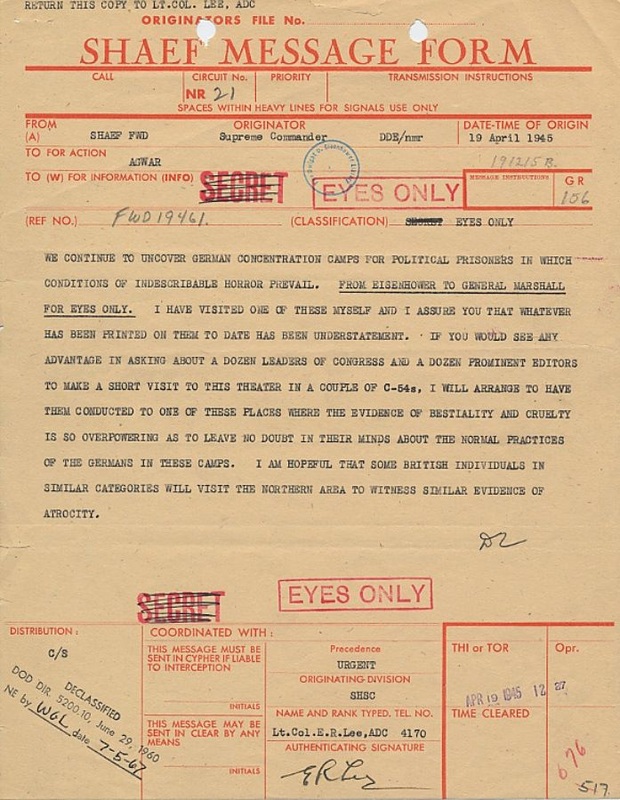
2 "I have visited one of these myself and I assure you that whatever has been printed on them to date has been understatement." Eisenhower to Marshall, April 19, 1945 General Dwight Eisenhower inspected the Ohrdruf Nazi labor camp on April 12, 1945, while touring forward battle areas. It was the first camp in Germany liberated by the Western Allies. Eisenhower told General George C. Marshall he toured the camp “in order to be in a position to give first-hand evidence of these things if ever, in the future, there develops a tendency to charge these allegations merely to ‘propaganda’…. “ Eisenhower told General Patton shortly after his visit to Ohrdruf that he wanted “every visitor” in the region to see the camps. A day later he wrote General Marshall requesting that he send “about a dozen leaders of Congress and a dozen prominent editors” to tour the camps. Ike also ordered German civilians living near the camps to see the horrors firsthand. "I’m not going to let anybody ever say again that all these stories are just made up," Eisenhower told a reporter in 1965, twenty years after his order to publicize the atrocities. Text via http://ourpresidents.tumblr.com/post/109299479929/international-holocaust-remembrance-day-general Teaching the Holocaust through Children's booksThis was the first Newbery Award winner by Lois Lowry. For those of you who haven't had the pleasure of reading this very accessible novel within easy reach of fourth or even third grade readers, it's the story of the determination of the people of Denmark to get the Jews to safety while the Nazis were equally determined to annihilate them.
Number the Stars by Lois Lowry. Students become acquainted with the threat to all citizens, especially to Jewish citizens, resulting from the imposition of Nazi authority and appreciate the courage exhibited by ordinary people acting out of conscience.
Number the Stars by Lois Lowry. A lesson based on this book. Grades 3 - 5 Number the Stars by Lois Lowry. This review by Carol Otis Hurst first appeared in Teaching K-8 Magazine. ____ See the story of a young Jewish girl discovering the Messiah’s faithfulness in the midst of the Holocaust, in “Trapped in Hitler’s Hell.” Link to the movie. Surviving Hitler: A Boy in the Nazi Death Camps. (HarperTrophy, 2002 ISBN 0060007672. )
Jack Mandelbaum had lived a comfortable life in Poland before the Holocaust began. After hiding for a while, his family was separated and Jack was sent to Blechhammer. This is his story of survival for three years at numberous Concentration camps. He is now the father to seven children and grandfather to more than a dozen. For sixth or seventh graders, the best approach might be through Jane Yolen's The Devil's Arithmetic (Puffin, 1990 ISBN 0140345353. This can be read aloud. The protagonist, Hannah, resents her family's preoccupation with the past and the Holocaust some of them survived. When selected to be the one to open the door for the prophet Elijah at the Seder, Hannah steps into the world of 1940s Poland. The concentration camp awaits.
made into a Movie found on Amazon Prime Johnston, Tony. The Harmonica. Illustrated by Ron Mazellan (Charlesbridge, 2004 ISBN 1570915474.
Given a harmonica from his coal-miner father in Poland, the child learns to play it before he is taken from his family and sent to the camps. There he is ordered by the commandant to play Schubert. Even the beautiful music cannot hide or change the cruelty. Lakin, Patricia. Don't Forget. (Aladdin, 2002 ISBN 0689848099.) An eight year old prepares to bake a cake for her mother and collects the ingredients from various storekeepers, all of whom are Holocaust survivors. The child observes the numbers tattooed on their arms. Wild, Margaret. Let the Celebrations Begin. Illustrated by Julie Vivas (Orchard, 1996 ISBN 053107076X.
The war is over and one young woman survivor at Bergen Belsen tells how she and the other women used scraps to make celebration toys for the children survivors just before liberation. Grade 5 and up Vos, Ida. Anna Is Still Here. (Puffin, 1995 ISBN 0140369090.
The war is over. Anna has come out from the attic where she hid alone for three years. Now she is trying to adjust to a life that includes parents and friends. One of those friends is Mrs. Neumann who waits in vain for her daughter to return. Grade 5 and up Williams, Laura. Behind the Bedroom Wall. (Milkweed, 1996 ISBN 157131606X.
Korinna is a loyal German citizen. She adores the Fuhrer and listens raptly to his radio addresses. Her parents encourage her participation in the Jungmadel, the Nazi youth organization. Then Korinna discovers that the sounds she has been hearing in her bedroom wall are not caused by mice, but by a Jewish woman and her five-year-old daughter. Korinna's duty is to turn them and her parents in to the Nazis. |
Multi Media Ideal to Introduce Children to the Holocaust
The Holocaust is a heavy topic and obviously prescreen any movie before showing it to your family. These shows do NOT have graphic scenes and it are great videos to watch to introduce the topic.
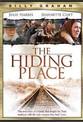
_______________________________ SURVIVORS of the CONCENTRATION CAMPS personal interviews Online Torchlighter Film Archive. Each year, during the official Holocaust Martyrs' and Heroes' Remembrance Day ceremony that takes place at Yad Vashem, six torches, representing the six million Jews, are lit by Holocaust survivors. Since 1995 short films depicting the stories of the survivors are shown as each torch is lit. All of these films, containing documentary footage and video testimony, can be accessed (by name, country, or year of ceremony) in the Auchweitz to Forgiveness no gore and a good message.https://www.youtube.com/watch?v=-gt6UnmjcDo Corrie Ten Boom (her story in her own words) A movie based on her life the Hiding Place (youtube) Free Study Guide for The Hiding Place by Corrie ten Boom The Hiding Place Study Guide by Progeny Press The Book Thief (I have yet to view) ______________________________________ Holocaust Rescuers Documentaries Righteous Holocaust Rescuers. A collection of 18 brave men, women and children who saved 1000's. -as collected by a home school teen Holocaust Heroes NICKY’S FAMILY The inspiring story of Englishman Nicholas Winton who helped hundred of children escape Nazi occupied Czechoslovakia. The documentary features interviews with the saved children (now elderly) and Winton himself as well as dramatic reenactments. Irena Sendler Short documentary on Sendler **Here's a documentary created by students in Kansas Irena Sendler _______________________________ **Actual Footage of bombing Pure History Specials - Hidden Heroes of the Holocaust: Remembering the Rescuers Underground Resistance in Holland attempts to rescue PRIMARY SOURCESSurvivors of the Concentration Camps
|
|
|
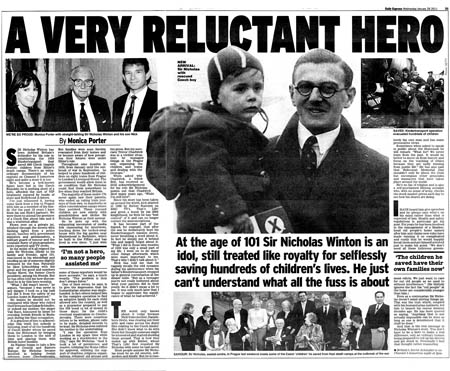
Sir Nicholas Winton
saves 669 children |
support from home...
BIOGRAPHIES of Heroes
Read about More Heroes during the Holocaust
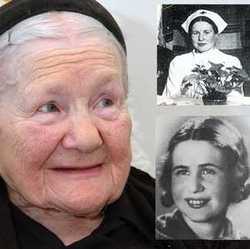
During WWII, she got permission to work in the Warsaw ghetto, as a Plumbing/Sewer specialist with an 'ulterior motive' - to smuggle out & save 2500 kids/infants. She was caught & Nazi's broke both her legs, arms & beat her severely. She kept a record of the names of each child in a glass jar, buried under a tree. After the war, she tried to locate parents that may have survived, to reunited the family. She was nominated for the 2007 Nobel Peace Prize. Irena Sendler, Died May 12, 2008 at age 98.
FIND OUT HOW STUDENTS MADE HER FAMOUS.
FIND OUT HOW STUDENTS MADE HER FAMOUS.
There are abundant resources for studying World War II online. This is a gathering of the resources we used for our study combined created a free home school curriculum with no additional textbook necessary. Hands on and interactive we have included links to lesson plans and websites dealing with the war itself, the war in Europe, the war in the Pacific, life on the home front, the holocaust and the bombing of Hiroshima and Nagasaki. We have a complete listing of the History Channel Speech Archive's World War II speeches. Other resources include songs of World War II, activities, books, and videos. As a child I loved reading historical fiction from this time period, my daughter follows in my footsteps. She will be providing reviews of books as part of her lessons.
1 http://www.ukemonde.com/holocaust/victims.html Overlooked Millions: Non-Jewish Victims of the Holocaust Karen Silverstrim, MA Candidate University of Central Arkansas
2 Image: Cable, General Eisenhower to General Marshall concerning Nazi horrors; requests visit by members of Congress and the media, April 19, 1945 [Dwight D. Eisenhower's Pre-Presidential Papers, Principal File, Box 134, Cables Off (GCM/DDE 19 Apr - 10 Nov 45 (4); NAID #12007738] Eisenhower Presidential Library and Museum
2 Image: Cable, General Eisenhower to General Marshall concerning Nazi horrors; requests visit by members of Congress and the media, April 19, 1945 [Dwight D. Eisenhower's Pre-Presidential Papers, Principal File, Box 134, Cables Off (GCM/DDE 19 Apr - 10 Nov 45 (4); NAID #12007738] Eisenhower Presidential Library and Museum
